
- 日本語
- ENGLISH
SHOSTAKOVICH, Dmitrii
ドミートリイ・ショスタコーヴィチ(1906.9.25-1975.8.9)
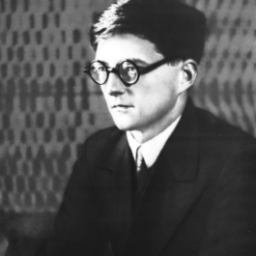
Born in Saint Petersburg in 1906. After graduating from the Petrograd Conservatory in 1925, he became one of the leading composers of the 20th century, awarded the highest honors under the Soviet regime: People's Artist of the USSR (1954), the Lenin Prize (1958), Hero of Socialist Labor (1966) the Stalin Prize (five times), the USSR State Prize (1968), and the RSFSR Glinka State Prize (1974).
His creative output was immense, leaving a colossal legacy in two major genres: 15 Symphonies and 15 String Quartets. His Symphony No. 7 "Leningrad" is globally recognized as a symbol of wartime resistance. Furthermore, he composed numerous other works including operas (e.g. Lady Macbeth of the Mtsensk District), ballets, six concertos, chamber music, film scores, and theater music. Internationally, he was nominated for the Oscars for his film music for Khovanshchina and was twice nominated for a Grammy Award for his Piano Concerto No. 2 and Symphony No. 4.
His career was filled with tension in his relationship with the Soviet authorities. Although his graduation piece, the First Symphony (1925), brought him immediate worldwide acclaim upon its 1926 premiere, his opera Lady Macbeth of the Mtsensk District was denounced in 1936 as "Muddle Instead of Music." His tactical response was the Fifth Symphony (1937), whose outwardly "triumphant" finale allowed it to be officially hailed as "the Soviet artist’s business-like creative response to fair criticism," thereby saving his career. Although in 1948 he faced the Zhdanov Decree for "bourgeois formalism," His legitimate standing as the USSR's leading composer was definitively restored only after Stalin's death in 1953, marked by the powerful premiere of his Tenth Symphony. He was served as Secretary of the Union of Composers of the USSR from 1957 to 1974, and Chairman of the Union of Composers of the RSFSR from 1960 to 1968. From 1937, he taught at the Leningrad Conservatory, and from 1943, he served as a professor at the Moscow Conservatory, mentoring many successors. Despite suffering from illness in his later years, he continued composing until shortly before his death in 1975, completing the Viola and Piano Sonata as his final, last completed work.
Shostakovich’s music, distinguished by its high compositional technique, masterful use of unique modalisms (such as the diminished fourth or hemiquart, often summarized by his monogram “D-Es-C-H”), and potent emotional depth, powerfully captured the tragedy, satire, and resilience of the 20th century.